
My NEO Group in Seoul, South Korea for GWA4.0
Participation of Dr Mickael Mosse highlights growing alignment between Web4.0 ecosystems and institutional financial infrastructure.
Date: April 29, 2026
Location: Seoul, South Korea
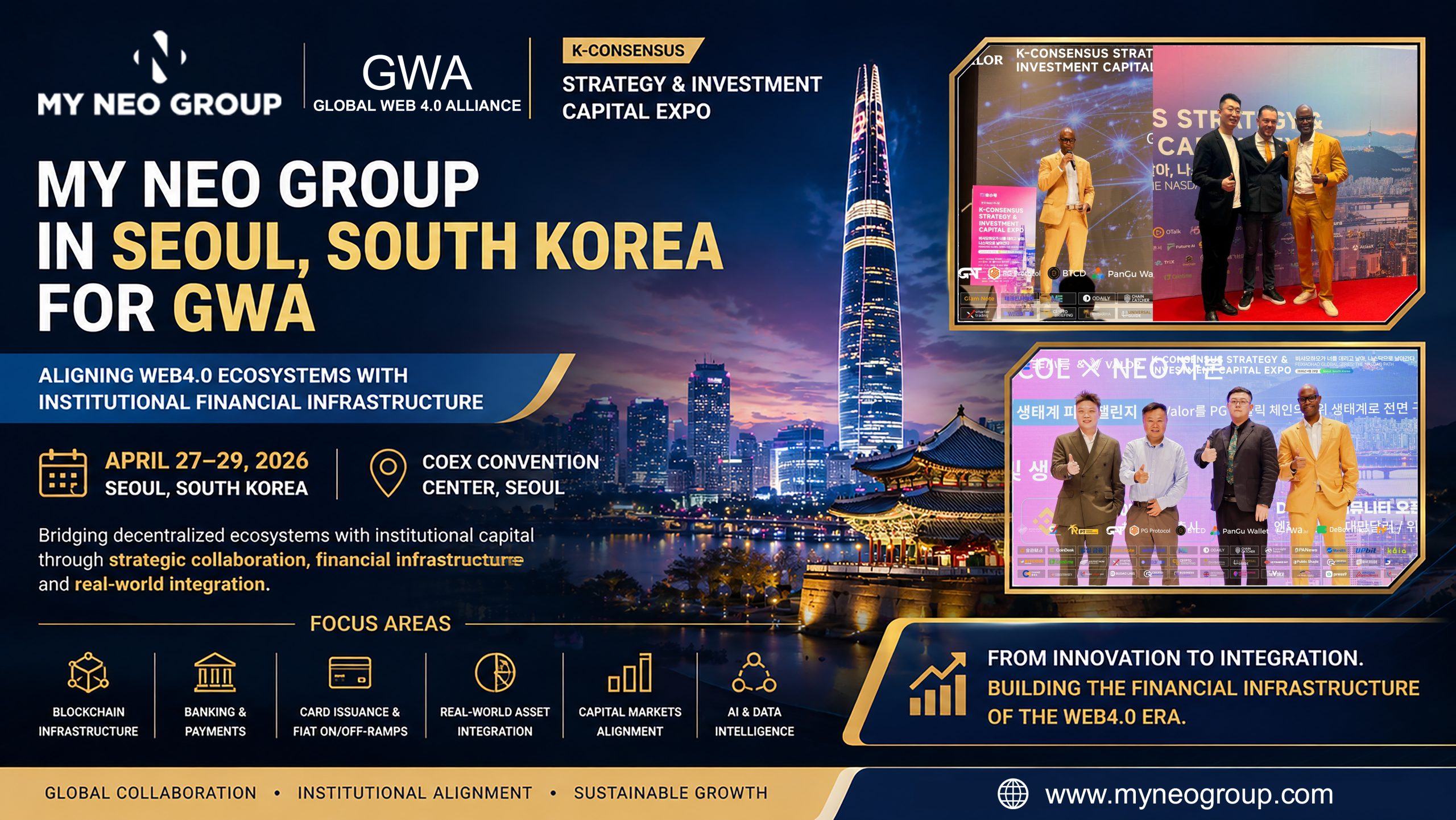
A new phase in the global structuring of digital finance took shape in Seoul this week, as industry participants gathered for a K-Consensus Strategy & Investment Capital Expo event, held in coordination with the broader Global Web4.0 Alliance (GWA) framework.
The presence of Dr Mickael Mosse, Group CEO and Founder of My NEO Group, who attended in person across April 27–29, reflects the increasing role of hybrid financial groups in bridging decentralized ecosystems with institutional-grade financial architecture.
From Ecosystem Fragmentation to Financial Structuring
The Seoul gathering forms part of an ongoing international series focused on connecting Web3 ecosystems with structured capital markets, including clearly defined pathways toward Nasdaq listings for selected entities.
This positioning marks a structural shift in the industry:
- From protocol experimentation to financial integration
- From token-driven narratives to capital market alignment
- From isolated ecosystems to coordinated infrastructure layers
Asia — particularly South Korea — continues to play a pivotal role in this transition, combining deep retail participation with rapidly evolving institutional frameworks.
GWA Framework Presented in Seoul
During the event, Olivier Fousse, Chief Operating Officer of My NEO Group, presented the architecture of the Global Web4.0 Alliance, emphasizing its role as a coordination layer rather than a standalone platform.
Rather than introducing a new platform, the GWA framework is designed to connect existing infrastructures into a coordinated financial system — reflecting a broader shift from fragmented innovation to aligned execution.
The model is built around interoperability between key components:
- Blockchain infrastructure and execution
- Banking, payments, and fiat connectivity
- Distribution and user ecosystems
- Data intelligence and analytics
- AI-driven systems and automation
- Capital markets and real-world asset integration
As a founding member of GWA, My NEO Group contributes to the financial and real-economy integration layer — positioning itself at the intersection of digital asset infrastructure and institutional finance.
Subtly embedded within the event structure, the collaboration between ecosystem participants — including My NEO Group — reflects an emerging model of coordinated development between infrastructure providers and financial operators.
Strategic Positioning of My NEO Group
Within this architecture, My NEO Group operates as a critical bridge between digital infrastructure and real-world financial systems — extending beyond participation to system-level integration.
This includes:
- Trading and liquidity infrastructure
- Banking and payment capabilities
- Card issuance and fiat on/off-ramps
- Real-world asset exposure through diversified platforms
“We are not building isolated systems — we are aligning financial infrastructure across multiple layers to enable real scalability.”
— Dr Mickael Mosse
“The objective of GWA is not to centralize, but to orchestrate — connecting technologies, capital, and users into a functional financial system.”
— Olivier Fousse
In parallel, several discussions referenced ongoing capital market structuring efforts aligned with a Nasdaq listing trajectory targeted for the second half of 2026, reflecting the maturation of certain ecosystem components toward public market readiness.
Second-Order Market Implications
Beyond the immediate announcements, the Seoul event highlights several deeper structural trends:
- Institutionalization of Web3 Growth Models — The explicit focus on Nasdaq pathways signals a transition toward traditional capital markets as the primary liquidity destination.
- Convergence of Retail and Institutional Dynamics — South Korea’s strong retail base is increasingly aligning with institutional standards, creating hybrid market conditions.
- System-Level Value Creation — Future competitive advantage is shifting from individual protocols to integrated, multi-layer ecosystems.
Leadership and Execution Dynamics
The dual presence of Dr Mickael Mosse and Olivier Fousse illustrates a combined strategic and operational approach:
- Vision-driven alignment of global financial infrastructure
- Execution-focused integration across products, markets, and jurisdictions
This reflects a broader industry evolution, where leadership increasingly requires the ability to coordinate across financial, technological, and regulatory domains.
Forward Outlook
While aligning decentralized ecosystems with institutional capital markets introduces complexity — particularly in governance, compliance, and cross-border execution — the direction of travel is becoming increasingly clear.
The Seoul event reinforces a broader transition:
- From experimentation to structured growth
- From fragmentation to interoperability
- From narrative-driven expansion to capital-driven validation
Conclusion
The Seoul gathering represents another step in the gradual convergence between digital assets and traditional finance. As the industry matures, the ability to integrate infrastructure, capital, and real-world access will define long-term success.
In that sense, coordination — rather than innovation alone — is emerging as the defining infrastructure of the next financial cycle. Within this evolving landscape, the role of coordinated frameworks such as GWA — and the participation of financial operators like My NEO Group — suggests that the next phase of Web4.0 will be shaped less by isolated innovation, and more by systemic alignment.